AI · 9 min ·
Building AI Agents That Actually Learn
Most AI agents today can plan, call tools, and generate responses. Very few can actually improve after every interaction.
Over the past year, AI agents have evolved from simple chatbot wrappers into autonomous systems capable of researching information, writing code, executing workflows, and interacting with external tools. Frameworks like LangGraph, OpenAI Agents SDK, CrewAI, Mastra, and AutoGen have made it easier than ever to build these systems.
However, building an agent is only half the challenge.
The real engineering problem is designing an agent system—an architecture that can reason, plan, recover from failures, evaluate itself, and gradually become better over time.
While experimenting with different architectures, I explored three patterns that repeatedly appear in production-grade AI systems. The third eventually became the foundation of Atlas, an open-source agent framework that learns from every interaction through reflection.
Let's dive in.
1. ReAct (Reason + Act) Systems
One of the most common architectures in modern AI agents follows a simple principle:
Don't trust the first answer.
Instead of generating a response once and returning it immediately, the system continuously evaluates its own work until it reaches an acceptable quality threshold.
A typical workflow looks like this:
- A research agent gathers information from the web, documents, or APIs.
- The collected information is sent to an evaluator (another agent or an LLM).
- The evaluator scores the response based on relevance, completeness, or confidence.
- If the score is below a predefined threshold (for example, 75%), the workflow loops back.
- The research agent collects more context and retries.
- Once the evaluation passes, the remaining workflow continues.
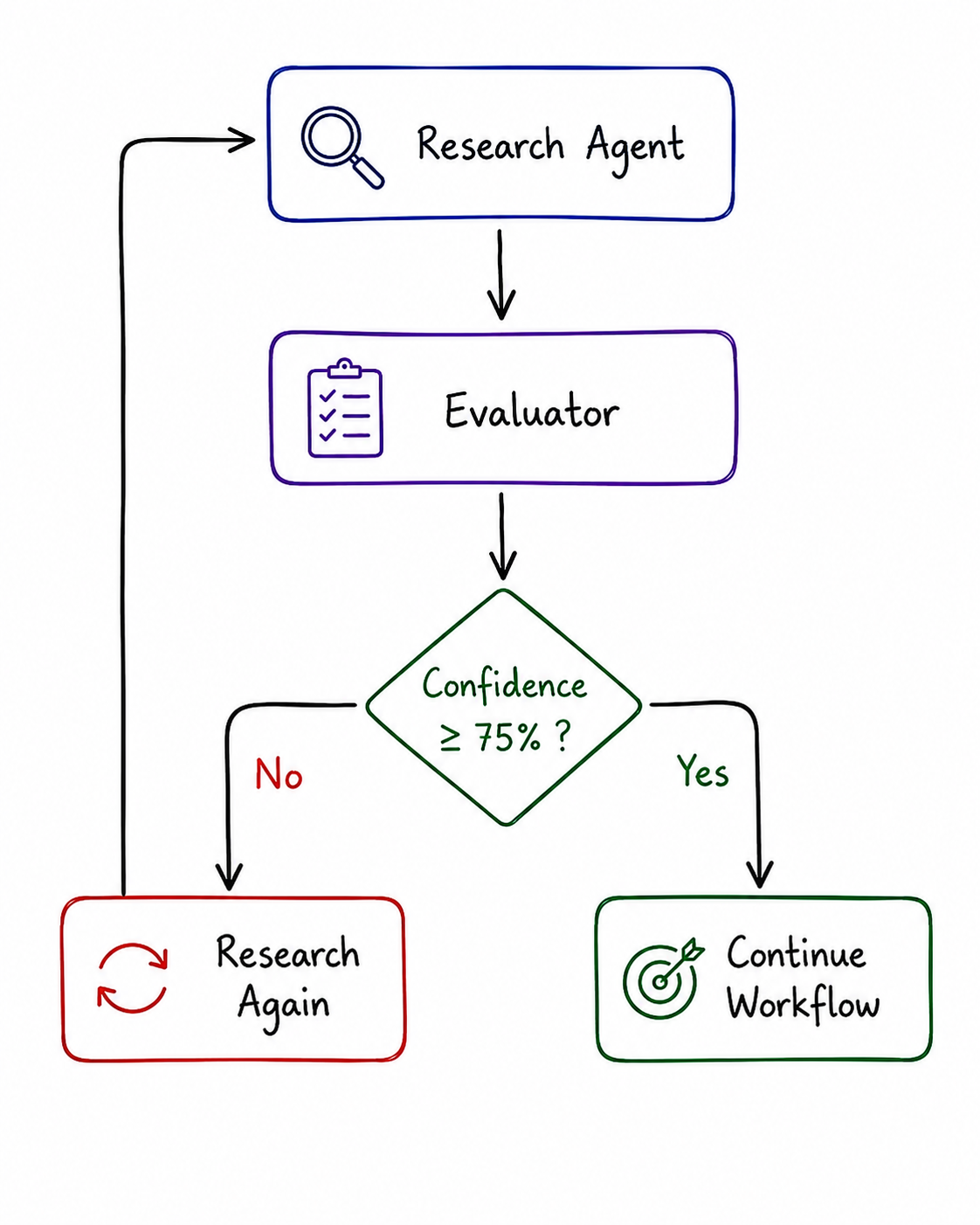
This feedback loop dramatically improves reliability because the system actively verifies its own output instead of assuming the first attempt is correct.
It's particularly effective for:
- Research agents
- Knowledge retrieval
- Report generation
- Multi-source information synthesis
2. Plan-and-Execute Systems
As tasks become more complex, asking one model to think and execute simultaneously becomes inefficient.
A better approach is separating planning from execution.
The workflow is straightforward:
- The Planner Agent receives the user's request.
- It decomposes the task into executable steps.
- It creates an execution plan.
- The Execution Agent follows that plan step by step.
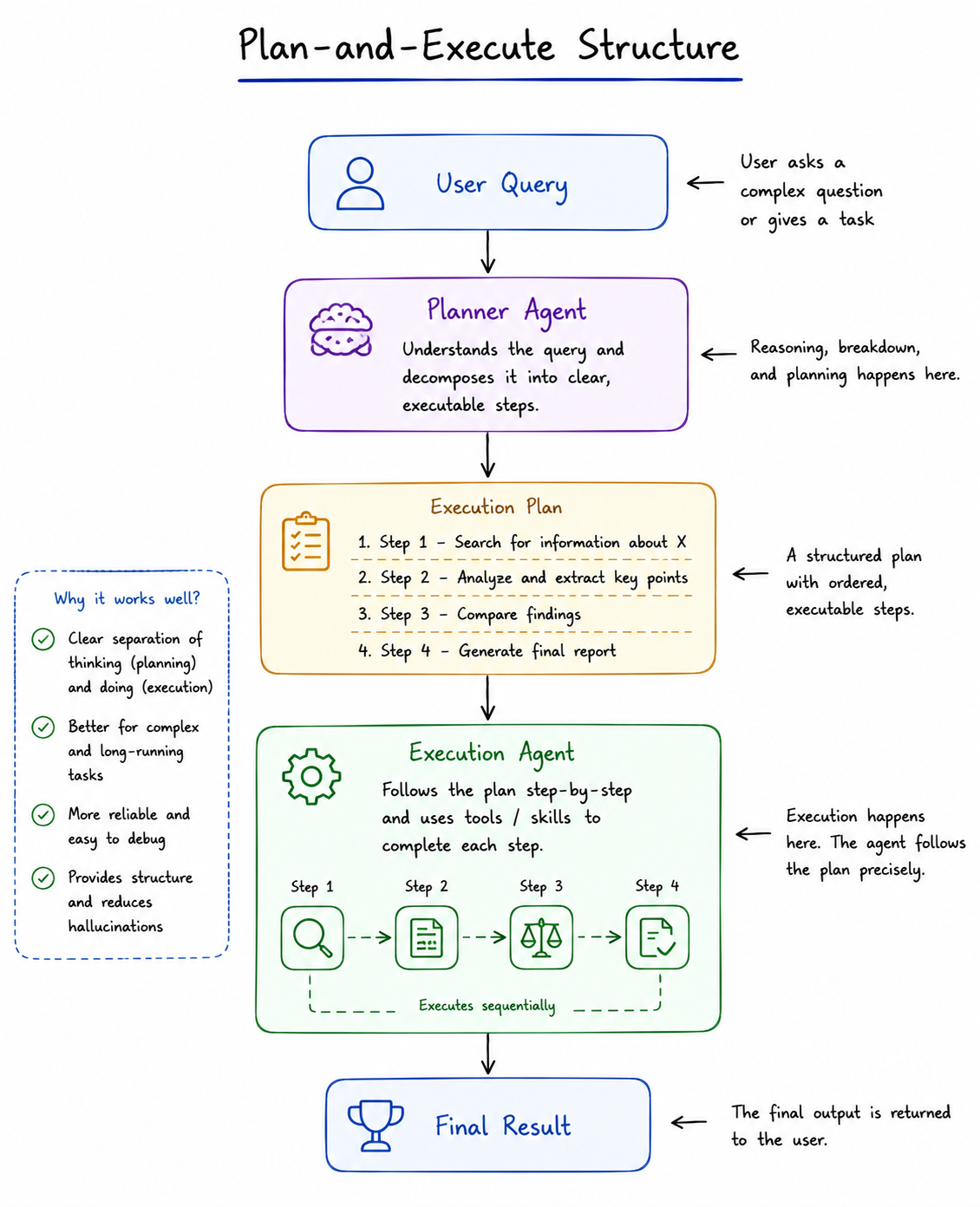
Separating responsibilities provides several advantages:
- Better reasoning
- Clearer execution paths
- Easier debugging
- More predictable behavior
- Better performance on long-running tasks
The execution agent no longer has to figure out what it should do—it only needs to execute the already-defined plan.
3. Reflection-Based Learning (The Architecture Behind Atlas)
While building agents, one question kept coming back:
Why should an agent forget everything after every conversation?
Humans improve because every interaction becomes experience.
Most AI agents don't.
That idea led me to build a reflection-based architecture for Atlas.
Instead of stopping once the response is generated, the workflow continues in the background.
The Architecture
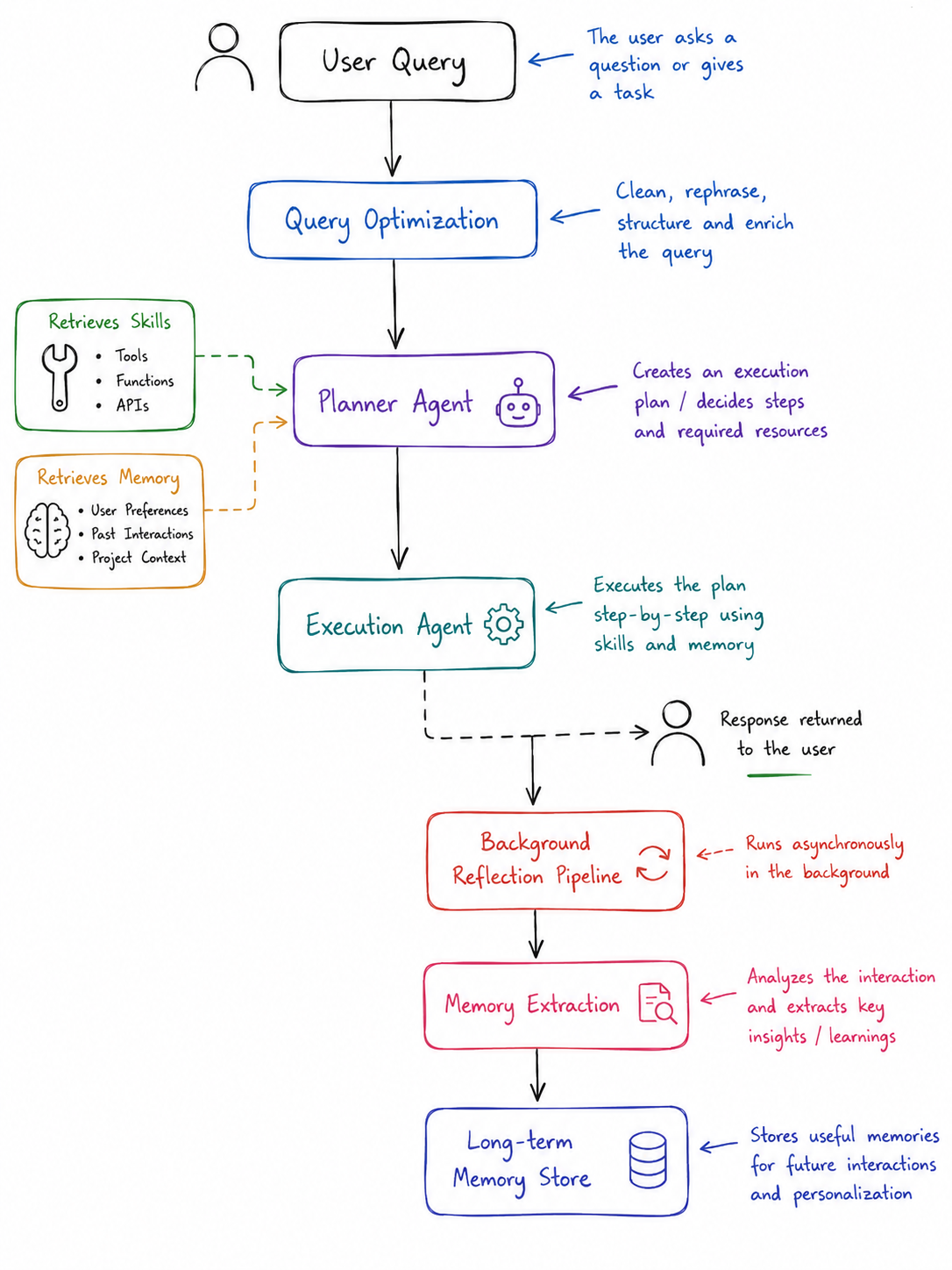
The key idea is simple:
The user never waits for reflection.
As soon as the execution agent finishes, the response is immediately returned.
Only then is an asynchronous background job started.
That background process analyzes:
- The original query
- The execution trace
- The generated response
- Tool usage
- Successes and failures
Instead of storing the entire conversation, it extracts only reusable knowledge.
Examples include:
- User prefers Bun over npm.
- User writes backend routes with
try-catch. - User prefers TypeScript.
- User follows a particular coding style.
- Frequently used frameworks.
- Project-specific conventions.
- Recurring workflow preferences.
The next time the user interacts with the system, those memories become additional context.
Over time, the agent gradually becomes more personalized without requiring the user to repeat the same instructions.
This pattern is conceptually similar to the long-term memory systems used by assistants like Hermes and Pi, although the exact implementations differ.
Why Reflection Matters
Traditional RAG gives agents access to external knowledge.
Reflection gives them access to experience.
That's an important distinction.
Instead of asking:
"What documents should I retrieve?"
the agent also asks:
"What did I learn from previous interactions that can help me perform better this time?"
That shift transforms an agent from a stateless executor into a continuously improving system.
Engineering Practices That Make Better Agents
Regardless of which architecture you choose, a few engineering principles consistently improve production systems.
1. Make Your Agent Measurable
If you can't measure quality, you can't improve it.
Use evaluation pipelines to track:
- Accuracy
- Tool usage
- Hallucination rate
- Formatting consistency
- Instruction following
- Failure cases
Reliable evaluation is one of the biggest differentiators between demo agents and production agents.
2. Write Better System Prompts
Your system prompt defines your agent's behavior.
For production systems, I rarely rely on zero-shot prompting.
Instead, I prefer one-shot or few-shot prompting.
Providing high-quality examples helps the model produce:
- More consistent formatting
- Better reasoning
- Higher-quality responses
- More predictable behavior
In practice, a few carefully chosen examples often outperform pages of instructions.
3. Use Chain-of-Thought for Sequential Workflows
Whenever a task involves multiple dependent steps—such as planning, coding, debugging, or research—the reasoning order matters.
Encouraging structured reasoning reduces logical errors and makes execution significantly more reliable.
4. Test Agents in Sandboxed Environments
Never rely solely on production testing.
Instead, isolate your agents inside controlled environments where you can:
- Replay conversations
- Benchmark prompts
- Compare different strategies
- Test new tools
- Reproduce failures
This makes debugging dramatically easier and accelerates iteration.
Where I Think Agent Systems Are Heading
Today's AI agents are already capable of planning and using tools.
The next generation won't just execute tasks—they'll continuously learn from them.
We'll likely see agent systems that:
- Build persistent long-term memory
- Learn user preferences automatically
- Adapt workflows over time
- Improve through reflection instead of retraining
- Become increasingly personalized with every interaction
The shift won't come from larger language models alone.
It will come from better architectures.
Final Thoughts
Building AI agents isn't just about connecting an LLM to a few APIs.
The real challenge is designing systems that can reason, plan, execute, evaluate, and eventually learn.
The reflection-based architecture described here is one approach I've been exploring while building Atlas, an open-source agent framework focused on long-term memory, extensible skills, and continuous improvement.
The project is still evolving, but the core architecture is already in place.
If you're interested in AI agent systems, I'd love for you to explore the Atlas repository on GitHub, experiment with the architecture, and share your thoughts. Contributions, feedback, and discussions are always welcome.
The future of AI isn't just smarter models.
It's smarter systems built around them.